Movement / Culture
RUN CLUBS ARE THE NEW NIGHTCLUBS. APPARENTLY WE'RE FLIRTING AT 7AM NOW.
The nightclub gave us darkness, anonymity and bad decisions. The run club gives us daylight, Strava and someone checking our kilometre splits afterwards.
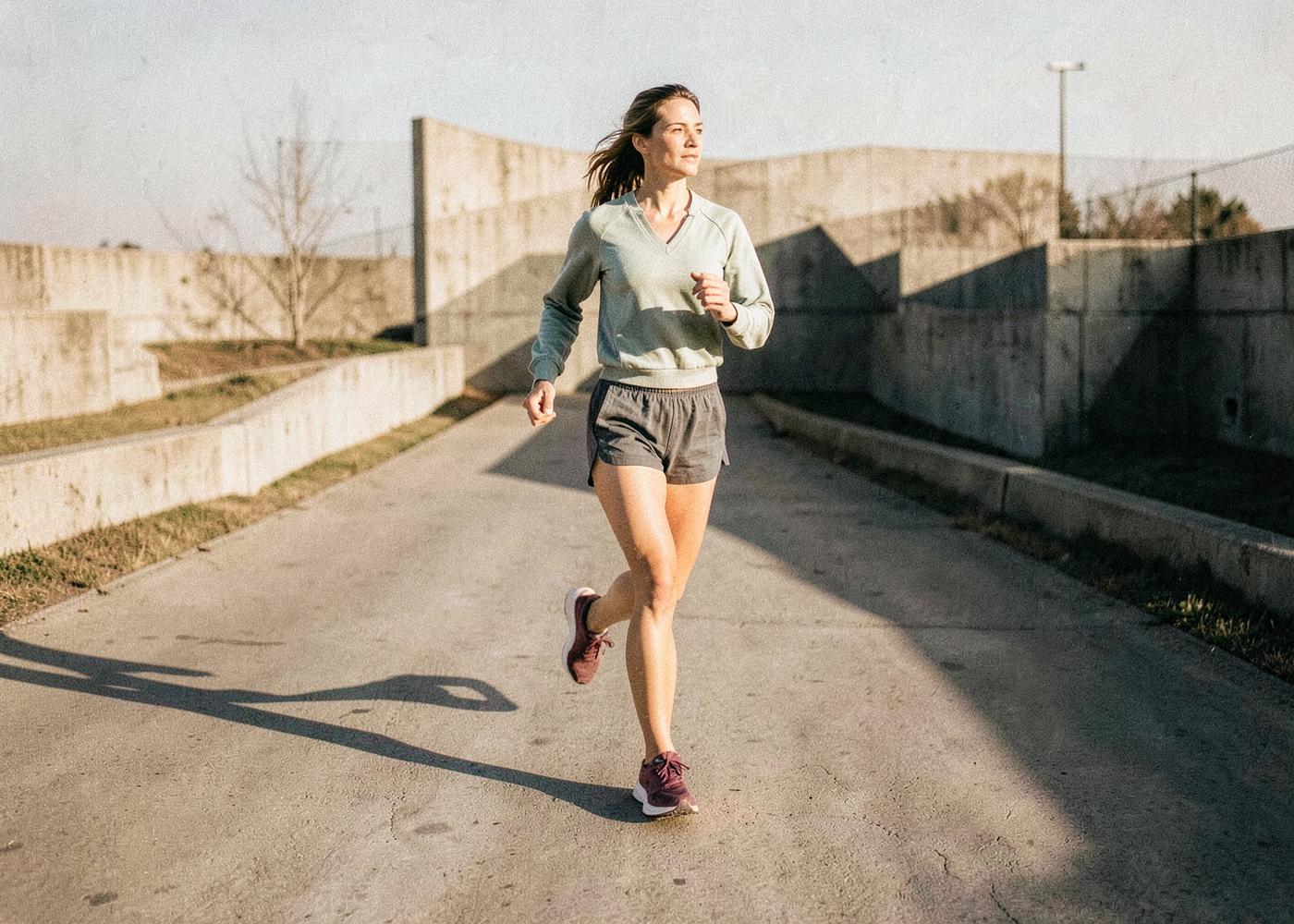
The nightclub gave us darkness, anonymity and bad decisions. The run club gives us daylight, Strava and someone checking our kilometre splits afterwards.
The story
There was a time when meeting someone involved alcohol, darkness, extremely loud music and staying awake considerably later than your body wanted.
You put on something slightly uncomfortable. You went somewhere you couldn't hear anybody. You drank enough to make talking to strangers feel less terrifying. If things went particularly well, you exchanged numbers at 2am while one of you was shouting WHAT? over a remix nobody had asked for.
Now, apparently, we're doing it in Hokas. At 7am.
The run club has somehow become one of the most socially loaded places in the modern city. What was once an activity associated with marathon training, middle-aged men in tiny shorts and people who genuinely enjoy discussing split times has been absorbed into culture. There are run-club TikToks, run-club outfits, run-club crushes, run-club dating jokes, run-club coffee dates and entire Reddit threads dedicated to finding the right one.
In Milan, the transformation is particularly obvious. Clubs run through Navigli, Porta Venezia and Parco Sempione, then end at cafés, pizzerias and aperitivo. Some explicitly describe themselves less as training groups than communities. One recent Milan collaboration combined an easy 5K with music, an aperitivo and something described, beautifully, as soft clubbing.
We have apparently invented the nightclub for people who want to be home by eleven.
And people are actually meeting there.
Recent Italian reporting has profiled couples who met through running clubs after repeatedly seeing each other at weekly sessions. One couple described it not as some cinematic love-at-first-sight moment, but as something that developed slowly after seeing each other twice a week.
Which, when you think about it, sounds almost suspiciously like how people used to meet before we turned dating into software.
This is why the story isn't really about running.
It's about the fact that we seem to have become desperate for somewhere to go.
Not a date. Not an event you bought tickets for six weeks ago. Not a group chat containing fourteen messages asking whether everyone can do Thursday.
Somewhere you can simply show up and reasonably expect other people to be there. For much of human history, this was not a particularly innovative concept.
People had pubs. Churches. Social clubs. Local cafés. Sports teams. Community organisations. Neighbourhoods where people actually knew the person living three doors away. Offices where colleagues were physically present five days a week. Friends of friends who kept appearing at the same parties until eventually they stopped being strangers.
Sociologists have a term for some of these spaces: third places. Home is the first place. Work is the second. The third is the café, bar, park, club, barber shop, community space or other informal setting where you repeatedly encounter people without needing a formal reason to see them.
And repetition is doing more psychological work here than it gets credit for.
Because one of the strangest things about modern dating is how much pressure we've placed on the first encounter.
Open Hinge.
Six photographs.
Three prompts.
Maybe his height.
Maybe his job.
Maybe a photograph of him holding a fish despite years of women begging men to reconsider the fish.
And from this information you are supposed to determine whether you would like to spend two hours opposite him.
Then you meet.
And the date itself has a job interview quality to it because both people know why they're there. There is no ambiguity. No gradual discovery. Nobody is pretending they happened to sit next to each other.
You have been algorithmically introduced for the purpose of potentially falling in love.
Good luck.
The run club does almost the opposite.
You see someone.
Then you see them again.
Maybe you speak for three minutes.
Next week they're there again.
You discover they're funny because they said something funny, rather than because their profile says “fluent in sarcasm.”
Attraction is allowed to arrive late.
Psychology has been interested in the effects of repeated exposure for decades. Familiarity does not magically make us fall in love with everybody we repeatedly encounter, thank God, but repeated contact can increase liking under the right conditions. More broadly, friendships and relationships have always benefited from something modern adult life has made weirdly scarce: unplanned, repeated proximity.
The run club manufactures it.
Same place.
Same day.
Same faces.
Again next week.
No “we should totally get coffee sometime” required.
And perhaps that's why the dating angle, while funny, is actually the least interesting part of the phenomenon.
People are looking for friends too.
They're moving cities. Working remotely. Spending more of their lives online. Dating apps solve dating badly enough, but there isn't even a universally accepted Tinder for I moved to Milan six months ago and would like three people to text on a Sunday afternoon.
Making friends as an adult is bizarrely difficult because friendship requires repetition but adulthood requires scheduling.
The run club quietly solves both.
You don't have to ask someone to become your friend.
You just keep running next to them.
Eventually you know where they work.
Then who they're dating.
Then why they hate their boss.
Three months later you're at their birthday dinner wondering when exactly this person stopped being somebody from running.
This may also explain why running has succeeded where so many explicitly social events feel slightly painful.
Nobody has to admit they're lonely.
You didn't join because you desperately wanted friends.
You joined because you are into running.
Even if you bought the shoes yesterday.
The activity gives everyone plausible deniability.
It removes the horrible pressure of an event whose sole purpose is MEET NEW PEOPLE, which tends to make everyone immediately forget how to behave around new people.
You have something to do with your body. Something to discuss. A reason to be there. Conversation can happen sideways rather than across a table while two strangers silently evaluate one another.
And if nobody interesting turns up?
You still went for a run.
This might be one of the reasons activity-based socialising is having such a moment beyond running too. Pilates events. Padel. Ceramics. Supper clubs. Book clubs. Walking groups. Cold plunges followed by matcha, because apparently simply meeting for coffee was not sufficiently optimised.
The activity is partly an excuse.
What we're buying is structured serendipity.
Which sounds like a contradiction because it is.
We want the spontaneity of meeting someone naturally, but our lives have become organised enough that spontaneity occasionally needs a calendar invite.
So we schedule the possibility of something unscheduled happening.
Tuesday. 7pm. Arco della Pace.
Be spontaneous.
There is another cultural shift hiding inside all this: alcohol is losing some of its monopoly on social life.
That does not mean Gen Z has collectively become sober and spends Saturday night foam-rolling. Bars are alive. Clubs are alive. People continue doing things to their livers that no wellness newsletter would endorse.
But alcohol no longer feels like the unquestioned entry ticket to socialising that it once did. Recent reporting on younger social scenes increasingly describes people looking for gatherings where drinking is optional rather than the entire architecture of the evening. Even college communities are experimenting with run clubs, Pilates events and matcha socials alongside traditional parties.
The social desire didn't disappear.
The format diversified.
Which makes the “run clubs are the new nightclubs” joke more revealing than it initially sounds.
Because the nightclub and the run club perform some surprisingly similar cultural jobs.
You dress for them.
There is music.
There are regulars.
There are people who take it far too seriously.
There is an implicit hierarchy.
There are people who came primarily to see their friends.
There are people who absolutely came to get laid but will deny this if asked.
And there is usually one person whose entire personality appears to have become the venue.
The biggest difference is that at one of them everybody smells terrible at the beginning of the night, and at the other everybody smells terrible at the end.
Of course, wellness culture being wellness culture, it has already managed to introduce status into what could have been a perfectly innocent jog.
There are the right shoes.
The right sunglasses.
The right socks.
The right club.
The right pace.
The Strava upload.
The branded collaboration.
The post-run coffee photographed in exactly the correct slightly sweaty way.
Some clubs are genuinely inclusive; others can look suspiciously like casting calls with electrolytes.
The nightclub had a door policy.
The run club has a pace group.
And there is something almost comical about replacing one form of social performance with another. We escaped dressing for the club and somehow ended up coordinating technical running vests.
But that doesn't make the underlying need less real.
In fact, the commercialization may be happening precisely because the need is so strong.
Community has become valuable.
Brands understand it. Restaurants understand it. Gyms understand it. Dating companies understand it. Anyone capable of gathering a few hundred interesting people in the same physical place on a recurring basis suddenly owns something the internet has spent twenty years accidentally making scarce.
Attention is easy to buy.
Belonging is not.
Maybe that is the real reason run clubs feel bigger than another fitness trend.
Running is almost comically simple. Put on shoes. Go outside. Move forward. There is no revolutionary technology involved.
What the club adds is other people.
And apparently that was the innovation we were waiting for.
So no, nightlife probably isn't dying.
People still want music, sex, strangers, stories, beautiful clothes, terrible decisions and the possibility that tonight might turn into something.
But maybe the definition of going out is expanding.
Sometimes the person you would once have met at 1am is now standing next to you at 7am, wearing tiny shorts and asking what pace you're running.
The nightclub gave us darkness, anonymity and bad decisions.
The run club gives us daylight, Strava and someone checking our kilometre splits afterwards.
I'm not convinced one is objectively more romantic.
But I understand why everyone keeps showing up.
Because underneath the running, the dating, the expensive shoes and the slightly ridiculous TikToks is something much simpler:
we needed somewhere to meet each other again.
“We needed somewhere to meet each other again.”
Reviewed for accuracy by WT Research Desk