Culture / Wellness
When Did Wellness Become a Performance?
We started measuring sleep, steps, recovery and routines. Somewhere along the way, taking care of ourselves also became something other people could see us being good at.
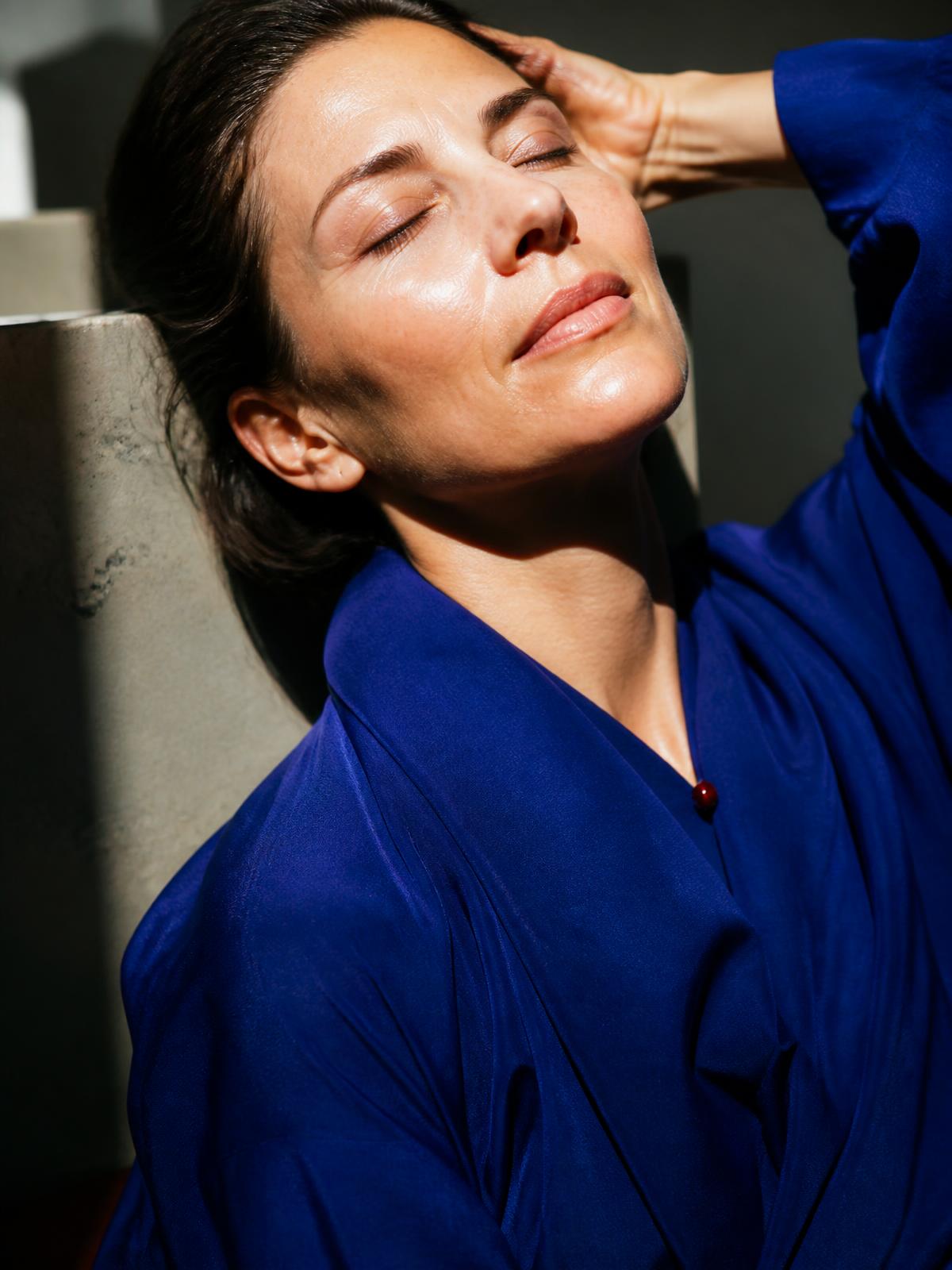
We started measuring sleep, steps, recovery and routines. Somewhere along the way, taking care of ourselves also became something other people could see us being good at.
The story
There was a time when going to bed early was something you did because you were tired.
Now you can wake up and receive a score for it.
You can inspect your deep sleep, REM sleep, resting heart rate, heart-rate variability, temperature deviation and readiness before you've even decided whether you personally feel awake. If the ring says you slept badly but you feel fantastic, there is a brief and genuinely confusing moment in which you have to decide who knows you better.
You.
Or the ring.
Then there is the morning routine. Electrolytes. Creatine. Supplements decanted into attractive little containers. Protein. Pilates. Eight thousand steps before lunch. Red-light masks that make perfectly normal women look like minor characters in a low-budget science-fiction film.
None of these things are necessarily ridiculous.
That's what makes this interesting.
Sleep matters. Exercise works. Protein matters. Strength matters. Sunscreen matters. Some supplements are useful in specific contexts. Walking is one of the least controversial things you can do for your health.
The strange part isn't that we started taking care of ourselves.
It's that taking care of ourselves became something other people could see us being good at.
Wellness used to be largely invisible.
You slept.
You ate.
You went for a walk.
You took your medication.
You went to the doctor.
Maybe you exercised.
Perhaps you owned vitamins in a deeply unattractive plastic bottle.
Now wellness has a visual language.
We know what a healthy person is supposed to look like before we know almost anything about their health.
The reformer.
The stainless-steel water bottle.
The expensive trainers.
The matcha.
The supplements.
The sauna.
The Oura ring.
The perfectly arranged refrigerator containing berries that somehow never rot.
A screenshot from Strava saying 8.42 km.
A screenshot from Oura saying 91.
A photograph leaving Pilates saying nothing at all because the grip socks have already explained the situation.
Health has become legible.
And once something becomes legible, it can become status.
That doesn't mean the person holding the matcha is pretending to be healthy. She may be extremely healthy. She may also simply enjoy matcha.
But the object is doing two jobs.
It is a drink.
And it is a signal.
We have always done this with objects. Clothes tell people things. Cars tell people things. Books on a coffee table tell people things, occasionally even that we have read them. Sociologists and psychologists have spent decades studying the ways consumption helps us communicate identity and group membership.
Wellness simply became exceptionally good material for it.
Because a Chanel bag says you can afford a Chanel bag.
A 7am Pilates class says something more complicated.
It says you can afford the class, certainly.
But it can also suggest discipline.
Time.
Taste.
Self-control.
Health.
A particular body.
A particular neighbourhood.
Possibly employment flexible enough to permit exercising while everyone else is answering emails.
Wellness is an unusually efficient status symbol because it can make privilege look like virtue.
And that is where things get psychologically interesting.
Because health behaviours are not only socially visible now.
They are increasingly measurable.
For most of human history, you could go for a walk without knowing precisely how many steps you took.
People somehow survived this.
Now you can walk 9,742 steps and experience the faint sense that something remains unfinished.
You can sleep for eight hours and be disappointed because the sleep score was 76.
You can run without uploading it to Strava, although there is a philosophical question as to whether the run then occurred.
You can eat dinner and know approximately how much protein it contained.
You can monitor glucose, recovery, heart rate, calories, menstrual cycles, body composition, hydration and stress.
The body has become a dashboard.
And dashboards do something very particular to the mind:
They give us something to improve.
This can be incredibly useful. Self-monitoring is a well-established behaviour-change tool. Tracking can make patterns visible that memory misses. It can motivate movement, improve adherence and help people understand their own behaviour.
But measurement also changes the experience of the thing being measured.
A walk can become 10,000 steps.
Sleep can become 85%.
Food can become macros.
A workout can become calories burned.
Recovery can become HRV.
Instead of simply asking How do I feel?, we acquire another question:
How did I perform?
And perhaps this is the quietest transformation wellness has undergone.
Health became a performance metric.
There is a psychological concept called self-determination theory that distinguishes, among other things, between motivation that feels internally chosen and motivation driven more heavily by external pressure, rewards or evaluation.
The distinction matters because humans tend to behave differently when an activity feels like something they genuinely want to do versus something they must successfully perform.
You can see the tension everywhere in modern wellness.
I love Pilates.
And:
I should go to Pilates.
I like walking.
And:
I haven't hit my steps.
I feel rested.
And:
My recovery score is terrible.
The behaviour hasn't necessarily changed.
The relationship to it has.
And there is another psychological mechanism underneath all this: identity.
Humans like coherence. We construct stories about the kind of person we are, then behave in ways that reinforce those stories.
I'm a runner.
I'm a Pilates person.
I'm sober.
I'm someone who takes care of herself.
I'm someone who wakes up early.
Identity can be incredibly powerful for behaviour change because it turns an isolated action into part of who you are. Going for a run becomes easier when running is not something you occasionally force yourself to do but something runners do.
The problem begins when the identity becomes more important than the function.
You stop asking:
Is this making my life better?
And start asking:
Is this what a healthy person would do?
Those questions sound almost identical.
They aren't.
A healthy person might skip the workout because she's exhausted.
A person performing health might go because missing it feels like failure.
A healthy person might eat the pasta.
A person performing wellness might spend dinner mentally calculating what needs to happen tomorrow to compensate for it.
A healthy person might stay out until 2am because the night is extraordinary.
A person performing wellness might leave because her sleep score is waiting.
And suddenly something designed to expand life begins quietly organising it.
This is where wellness acquires a moral dimension.
Health has always carried some morality. Humans are remarkably talented at turning circumstances into character judgments. But modern wellness has given us an unusually detailed vocabulary for being good.
Disciplined.
Consistent.
Clean.
Balanced.
Regulated.
Optimised.
And therefore, by implication, there are ways of being bad.
Lazy.
Undisciplined.
Inflamed.
Dysregulated.
Toxic.
Off routine.
The language is revealing.
We don't merely say we haven't exercised.
We say we've fallen off.
We don't simply return from holiday.
We reset.
We don't eat differently for a weekend.
We need to get back on track.
Track to where?
Presumably the place where everyone is drinking electrolytes.
Wellness has become one of the few forms of consumption where buying more things can be framed as self-discipline.
The €300 device isn't indulgence.
It's an investment in recovery.
The supplement subscription isn't shopping.
It's longevity.
The expensive retreat isn't a holiday.
It's nervous-system regulation.
This is extremely convenient for an industry trying to sell us things.
If fashion sells aspiration by suggesting this will make you look better, wellness can sell something even more powerful:
this will make you better at being a person.
Healthier.
Calmer.
More disciplined.
More productive.
More energetic.
More attractive.
More emotionally regulated.
Possibly immortal, if the supplement copywriter has had enough coffee.
And because health is genuinely valuable, the sales pitch is unusually difficult to argue with.
Who doesn't want to sleep better?
Who doesn't want more energy?
Who doesn't want to live longer?
The market doesn't need to invent the desire.
It only needs to keep expanding the number of things required to satisfy it.
This is how taking care of yourself can slowly become a second job.
There is always another variable.
Maybe you're exercising, but are you strength training?
Maybe you're strength training, but are you eating enough protein?
Maybe you're eating enough protein, but what about your gut?
Your cortisol?
Your glucose?
Your zone two?
Your VO2 max?
Your mobility?
Your lymph?
Your fascia?
Your sleep architecture?
Your morning light?
Your evening light?
Your red light?
At some point you realise that being alive apparently requires considerable project management.
And underneath all this optimisation sits a psychological promise that is much older than the Oura ring:
control.
Bodies are frightening because they are not entirely controllable.
We age.
We get sick.
People with impeccable routines develop diseases.
People who smoke occasionally live to 95, which is deeply irritating to everybody following the rules.
You can do many things that meaningfully improve your odds.
You cannot turn your body into a certainty.
Wellness sometimes allows us to forget this.
If every biological outcome can be connected to a behaviour, then perhaps every outcome can be prevented with enough discipline.
If I sleep correctly, eat correctly, exercise correctly, supplement correctly, manage stress correctly and monitor the correct numbers, perhaps nothing bad will happen.
Psychologically, that's an extremely seductive proposition.
It is also not how biology works.
Which is why the healthiest-looking person on Instagram is not necessarily the healthiest person in the room.
We cannot see blood pressure.
We cannot see insulin sensitivity.
We cannot see depression.
We cannot see cardiovascular fitness from a bathroom selfie.
We cannot see whether someone has a peaceful relationship with food.
We cannot see whether the woman posting the perfect morning routine actually feels good.
But we can see the performance.
And social media loves what can be seen.
So wellness naturally selects for the photogenic parts of health.
Pilates photographs beautifully.
A colonoscopy does not.
Matcha photographs beautifully.
Taking your antidepressant does not.
A sauna photographs beautifully.
Calling your mother because you've been lonely all week does not.
A beautiful supplement cabinet photographs beautifully.
Getting eight hours of sleep and forgetting to tell anybody about it is terrible content.
Some of the most important things we do for our health are almost completely invisible.
That might be the distinction worth protecting.
There is being healthy.
And there is being good at wellness.
Sometimes they overlap.
Often they do.
But they are not the same thing.
Being good at wellness is legible. You know the vocabulary. You own the objects. You understand the routines. You can discuss protein and cortisol and creatine and sleep architecture. You know which sauna blanket everybody has.
Being healthy is much less glamorous.
It might mean taking the medication.
Eating enough.
Sleeping.
Having friends.
Going outside.
Moving your body regularly.
Getting the boring screening test.
Leaving a terrible relationship.
Drinking less.
Laughing more.
Doing the physio exercises nobody will ever see.
And sometimes, perhaps, staying at dinner.
Because the night is good.
Because everyone you love is there.
Because somebody ordered another bottle of wine.
Because you are laughing so hard your stomach hurts.
Because tomorrow's readiness score is allowed to be 71.
This is not an argument against wellness.
Quite the opposite.
Taking care of ourselves is one of the great privileges of being alive. Science has given us extraordinary tools for understanding our bodies. Exercise is wonderful. Sleep matters. Prevention matters. Tracking can be useful. Pilates is great. Buy the LED mask if the evidence is good and you can afford it.
The question is simply what all of it is for.
If the routine gives you more energy to live, wonderful.
If the tracking helps you understand yourself, wonderful.
If exercise makes you stronger, happier, more capable and more alive, wonderful.
But if taking care of your life slowly becomes the main activity of your life, something has gone slightly wrong.
Health is supposed to give us more life.
Not more homework.
So maybe the question isn't whether we're doing wellness correctly.
Maybe it's whether wellness is still doing what we hired it to do.
Do we want to feel good, or look like people who feel good?
Ideally, both.
But if we ever have to choose, I know which one I'd rather keep.
“Health is supposed to give us more life. Not more homework.”
Reviewed for accuracy by WT Research Desk