Beauty / Business
BEAUTY BROKE OUR SKIN. THEN SOLD US THE CREAM TO FIX IT.
Skincare taught us to optimise our faces, then built an entire recovery category for the moment our skin asked us to stop.
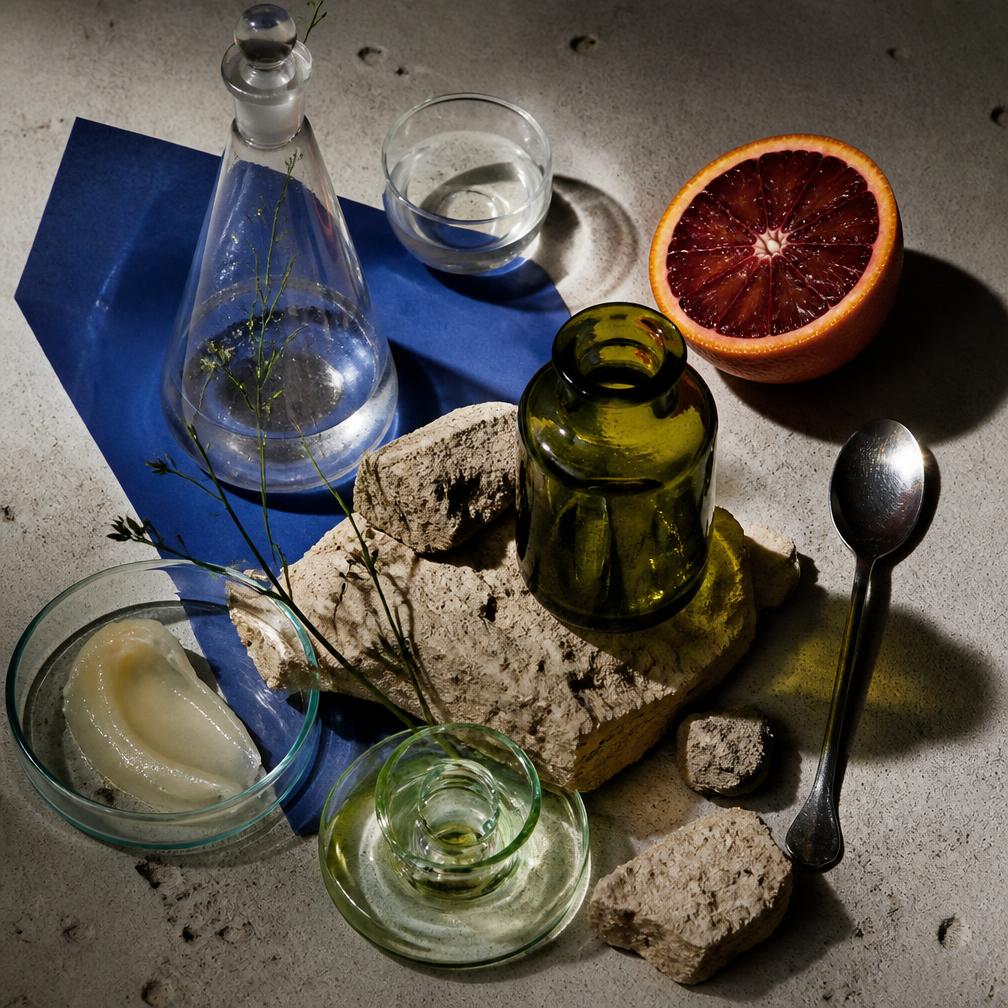
Skincare taught us to optimise our faces, then built an entire recovery category for the moment our skin asked us to stop.
The story
There is something almost too perfect about the modern skincare shelf.
On one side: the products designed to make your skin do more. Retinol to increase cell turnover. Acids to exfoliate. Vitamin C to brighten. Treatments for pores, pigmentation, texture, acne, fine lines and several other things you hadn't realised were problems until somebody filmed them in 4K.
And next to them sits an entirely different category.
The recovery products.
Barrier cream. Recovery balm. Ceramide serum. Soothing essence. Rescue mask. Products designed to calm, replenish and repair the skin after it has become dry, irritated, sensitive or generally furious.
Sometimes the same brand will happily sell you both.
You have to admire the efficiency.
Beauty has always been very good at creating desire, but modern skincare has developed a particularly sophisticated commercial loop. First we learned that our skin could be improved. Then we learned enough science to become ambitious about improving it ourselves. Then, after years of actives, acids, peels and increasingly complicated routines, we discovered another fascinating thing about our skin:
it occasionally wanted us to leave it alone.
Naturally, there is now an entire category of products to help us do that.
The easy version of this story would be that the beauty industry damaged everyone's skin and then invented “barrier repair” as another excuse to sell moisturiser at €68.
It's a fantastic headline.
It's also not quite true.
The skin barrier is real. Irritation from skincare is real. Ceramides are real. Retinoids and exfoliating acids have genuine uses. Properly formulated barrier-support products can be useful. Some people have barrier dysfunction because of inflammatory skin conditions, genetics or environmental factors that have nothing to do with TikTok.
But commercial systems don't need to invent a problem from nothing to profit from it. Sometimes the more interesting business is taking something real, making millions of people intensely aware of it, and then creating an increasingly elaborate market around managing it.
That is what happened to skincare.
For decades, prestige beauty sold mostly through fantasy. The cream came in a beautiful jar. The advertisement contained an impossibly luminous woman. The copy promised youth, radiance or some mysterious botanical discovered in a place nobody reading the advertisement had visited.
Then something changed.
Beauty discovered ingredients.
Retinol wasn't simply a cream. It was an active. Glycolic acid did something. Vitamin C had a mechanism. Niacinamide had studies. Hyaluronic acid sounded sufficiently medical that for a while half the internet seemed to believe it was an exfoliating acid rather than a humectant.
Suddenly skincare could sell intelligence alongside aspiration.
The consumer changed with it. She no longer wanted to be told that something was luxurious. She wanted to know the concentration. She wanted before-and-after photographs, dermatologist TikToks, ingredient breakdowns, clinical claims and a Reddit thread containing 600 strangers arguing about whether the formulation was worth €42.
This was one of the better things to happen to beauty. Consumers became more sceptical of meaningless claims. Dermatology became culturally interesting. Evidence-based ingredients became easier to understand and, in many cases, easier to access.
But knowledge did something else too.
It turned the face into a project.
Once you understand that different ingredients can target different concerns, it becomes extremely difficult for an industry built around selling products not to discover an ever-expanding list of concerns.
Texture.
Pores.
Fine lines.
Pigmentation.
Dullness.
Redness.
Congestion.
Uneven tone.
Loss of firmness.
Dehydration.
Post-acne marks.
Sebaceous filaments.
The last one is particularly impressive because millions of people managed to have noses for decades without realising the completely normal dots on them required a name.
The beauty industry didn't invent every concern on that list. Some are medical, some are cosmetic, some genuinely bother people and some respond well to treatment. But the psychological effect of categorising the face into increasingly precise opportunities for improvement is worth noticing.
A face stops being a face.
It becomes a collection of variables.
And variables invite intervention.
This is one of consumer culture's oldest tricks, although “trick” makes it sound more conspiratorial than it usually is. Markets grow by finding unmet needs, and once obvious needs have products, companies become very good at identifying more specific ones. Shampoo becomes shampoo for coloured hair, fine hair, dry hair, damaged hair, curly hair and scalp health. Water becomes hydration, electrolytes and functional beverages. Sleep becomes mattresses, trackers, supplements, cooling systems, mouth tape and something called a sleepmaxxing routine.
Skincare simply became exceptionally good at segmentation because every face contains almost unlimited detail.
Then social media gave us a magnifying glass.
We began looking at skin at a distance from which skin was never designed to be evaluated. Front-facing cameras, macro lenses, beauty content and before-and-after videos turned normal texture into visual information. Once you have stared at your own pores under bathroom lighting while holding an iPhone six centimetres from your nose, it becomes surprisingly easy to believe action is required.
And action is satisfying.
This part matters because skincare isn't only commerce. It is psychology.
Applying something gives us the feeling that we are doing something about a problem. It creates agency. Wait twelve weeks and see what happens is emotionally inferior to apply this tonight.
A product is a plan.
The more uncertain the problem, the more appealing the plan can become.
Perhaps this is why skincare routines became so elaborate. Each bottle represented a small piece of control: this for the pigmentation, this for the texture, this for ageing, this for hydration. The routine transformed a messy biological process into a sequence of manageable steps.
Cleanse. Treat. Correct. Hydrate. Protect.
Very reassuring.
The skin, unfortunately, doesn't know that you've made a spreadsheet.
More products do not automatically produce more benefit, and effective ingredients can still irritate. In a 2026 survey of dermatologists, 91.6% said they were concerned about the popularity of multi-step skincare routines, while 88.1% reported regularly encountering skincare-related skin problems. Retinoids, exfoliating acids and fragrances were among the products frequently associated with complaints. Yet nearly 80% of those dermatologists also acknowledged benefits from contemporary skincare trends, including greater awareness of skin health and sun protection.
That is the entire modern beauty industry in one finding.
We know more.
We have better products.
And somehow we have also found more sophisticated ways to annoy our faces.
None of this makes retinol bad. Retinoids have some of the strongest evidence in skincare. Acids can be extremely useful. Acne treatments can transform someone's skin and quality of life. The point is not that active skincare was a scam.
The point is that efficacy created another market: tolerability.
Once enough consumers were using effective ingredients, there was commercial value in helping them tolerate those ingredients. Once “damaged barrier” became common vocabulary, products that previously might have been described simply as moisturising or soothing could be positioned around a much more specific, and considerably more compelling, problem.
Moisturiser sounds optional.
Barrier repair sounds urgent.
That difference is worth a lot of money.
Language changes markets because language changes what consumers believe they are buying. “Dry skin” is an annoying condition. A “compromised skin barrier” sounds like infrastructure failure.
You don't moisturise infrastructure failure.
You intervene.
And beauty brands did.
Ceramides moved from dermatological formulations into mainstream beauty vocabulary. Products began talking about barrier lipids, microbiomes, recovery and resilience. Brands increasingly positioned
themselves around sensitive skin, overtreated skin and post-procedure recovery. The aesthetic changed too. Clinical typography, pharmaceutical references and laboratory language made products look less like indulgence and more like treatment.
Beauty started borrowing the authority of medicine precisely as consumers became suspicious of beauty marketing.
Which is clever.
But again, annoying for anyone hoping for a simple villain: much of the underlying science is legitimate. Ceramides are important components of the stratum corneum's lipid matrix, and appropriately designed topical formulations can support barrier function. Research also suggests that formulation matters; putting “ceramides” on the front of a bottle does not automatically tell you whether the product recreates the lipid organisation required for effective barrier support.
So the cream might work.
The marketing might also be brilliant.
Both things can be true at once.
That is probably the most useful way to understand modern wellness commerce generally. We tend to divide products into two categories: legitimate science or marketing bullshit. But the most successful categories often live somewhere much more uncomfortable.
The science is real.
The problem is real.
The product may work.
And the market can still dramatically expand how much attention you devote to the problem.
Think about sleep. Sleep matters enormously. Then we built an industry capable of making people anxious about whether they were sleeping correctly.
Think about food. Nutrition matters enormously. Then we created an environment in which a person can spend twenty minutes in a supermarket comparing two yoghurts because one contains four more grams of protein.
Think about skin. Barrier function matters enormously. And now somebody can have perfectly ordinary skin and wonder whether she needs a €90 serum to make her barrier more resilient.
The wellness economy rarely needs to convince us to care about something meaningless.
It is much more powerful when it takes something genuinely important and convinces us to care about it constantly.
There is another strange thing about the barrier boom: it represents a reversal in beauty's idea of progress.
For years, progress meant doing more. Stronger treatments. Faster turnover. More dramatic exfoliation. More visible transformation. Beauty advertising loved words that implied action: renew, resurface, correct, transform.
Barrier culture introduced almost the opposite fantasy.
Calm.
Restore.
Protect.
Support.
Do less.
Except, naturally, you can buy five products to help you do less.
This may be the most beauty-industry thing that has ever happened.
We turned restraint into a routine.
The same contradiction appears in “skinimalism,” another idea that periodically returns whenever consumers become exhausted by their own bathrooms. The promise is seductive: fewer products, better products, a simpler relationship with your face.
Then brands release products for skinimalism.
There is a cleanser for simplifying.
A serum for simplifying.
A moisturiser for simplifying.
Possibly an essence for simplifying, which feels philosophically ambitious.
Capitalism is extraordinarily good at selling us our escape from capitalism.
But it would also be unfair to pretend consumers are passive victims being manipulated by an evil jar of moisturiser. We participate enthusiastically because skincare is pleasurable.
There is pleasure in the bathroom shelf.
Pleasure in opening the box.
Pleasure in the routine.
Pleasure in discovering something that works.
Pleasure in knowing more than you did before.
Pleasure in sending your friend a product and saying, buy this immediately.
Beauty has always been partly about transformation, but it is also about play, taste, identity and hope. A skincare product is a tiny future tense. You apply it because you believe tomorrow's face might be slightly different.
There is nothing inherently wrong with that.
The problem comes when improvement becomes the default relationship we have with our bodies.
Because if every concern can be targeted, every surface monitored and every biological process optimised, there is no obvious point at which the project ends.
Clearer.
Brighter.
Smoother.
Stronger.
Calmer.
More resilient.
And when the skin finally objects?
Repair it.
Then begin again.
Perhaps that is why the skin-barrier story feels bigger than skincare. It reveals something about the modern wellness consumer: we have become extraordinarily educated about our bodies while simultaneously becoming extraordinarily good customers for anything that promises greater control over them.
The beauty industry didn't invent our desire to look good. It didn't invent acne, ageing, pigmentation, dryness or irritation. It didn't invent the skin barrier.
What it did was build an increasingly sophisticated commercial system around our ability to notice, name and act on almost every part of ourselves.
Sometimes that system gives us genuinely excellent products.
Sometimes it gives us problems we didn't know we had.
Often it gives us both in the same order.
Which is why the modern bathroom shelf is such a perfect artefact of the era. There is the product designed to change the skin, the product designed to help the skin tolerate being changed, and perhaps another product designed to repair it when tolerance runs out.
All beautifully packaged.
All scientifically worded.
All waiting for tonight.
Beauty didn't have to invent the problem. It only had to make sure there was always something left to improve.
“Sometimes the same brand will happily sell you both. You have to admire the efficiency.”
Reviewed for accuracy by WT Research Desk