London / Field notes
The Ponds Are Not a Performance Hack
Hampstead’s cold water has history, rules and real risks. It does not need a miracle claim to be one of London’s most convincing rituals.
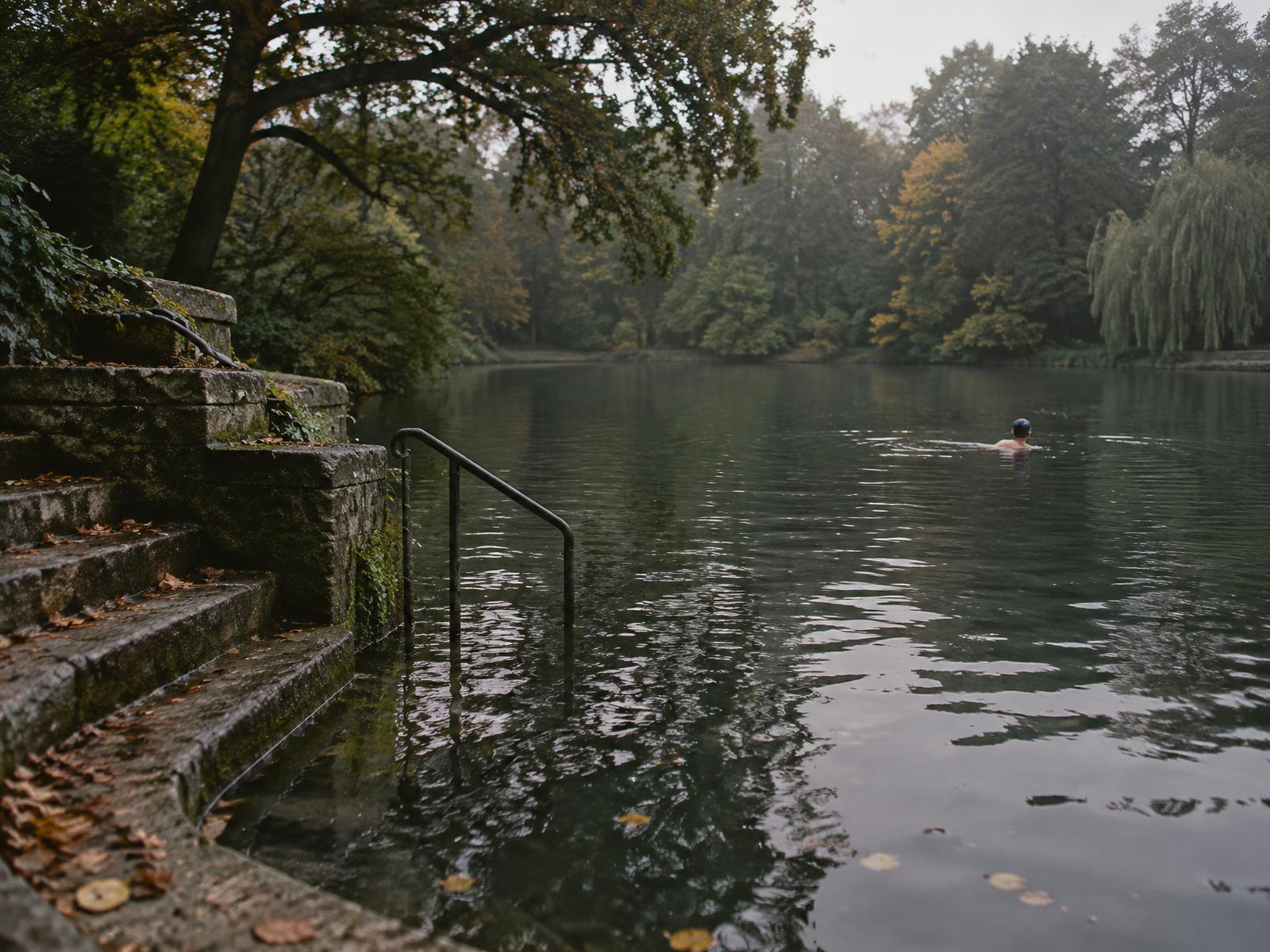
Hampstead’s cold water has history, rules and real risks. It does not need a miracle claim to be one of London’s most convincing rituals.
A London room without walls
Hampstead Heath has many versions of London inside it. There is the skyline from Parliament Hill, all proof and ambition. There are muddy paths that make expensive shoes look ridiculous. Then there are the bathing ponds: dark water, wooden platforms, birds in the margins and a social order built around getting in rather than talking about getting in.
They are often photographed as a shorthand for wild swimming, but the phrase can flatten what is unusual here. These are not remote lakes discovered by an outdoor brand. They are managed public bathing places inside a capital city, with lifeguards, changing areas, regular swimmers, entry rules and a history older than the wellness industry by several centuries.
The ritual is simple enough. Arrive with more layers than seem necessary. Change. Listen to the lifeguard. Enter water that is deeper, darker and less predictable than a pool. Swim within your capacity. Get out before courage becomes stupidity. Drink something hot. The fact that none of this requires a wearable is part of its appeal.
“The water is cold. The claims around it should remain cooler.”
Reservoirs before rituals
The ponds began as infrastructure. From the late seventeenth century, a chain of reservoirs was created on the Heath to hold water from springs feeding the River Fleet. The Hampstead Water Company was incorporated in 1692. Over time, practical bodies of water became places for recreation, argument and belonging.
Three are now designated for bathing. Highgate Men’s Pond and Kenwood Ladies’ Pond operate throughout the year, while Hampstead Mixed Pond is seasonal. Their separation reflects a long social history rather than a contemporary wellness concept. The Men’s Pond became a formal public facility in the nineteenth century. The ponds have since accumulated generations of regulars, local rules and fierce affection.
That affection has repeatedly become political. When closure was considered in 2004 amid funding and safety concerns, swimmers campaigned to keep the ponds open. Charges followed in 2005. In the same period, the Hampstead Heath Winter Swimming Club won a High Court case that allowed tightly governed, self-regulated early winter swimming under club arrangements. The history is less a story of effortless tradition than of a public place repeatedly negotiated and defended.
Access remains a live question. After a large public consultation in 2025, the City of London Corporation confirmed in June 2026 that the Ladies’ and Men’s Ponds would remain trans-inclusive, with the Mixed Pond open to all. Any article that turns the ponds into pure atmosphere misses that they are civic spaces, shaped by law, policy, maintenance and the people who use them.
How to swim there now
The most useful advice is also the least romantic: check the City of London Corporation website before leaving home. Opening hours change with the season. Summer combines bookable and drop-in sessions, while arrangements outside the busiest period differ. Advance slots can disappear quickly in warm weather. The Mixed Pond closes for part of the year, while the single-sex ponds have year-round schedules.
At the time of publication, bookings are released daily at 8pm for dates up to seven days ahead. Adult pond entry is listed at £5, with concessions available, but prices and systems change. The official page should always outrank an old social post, a search snippet or this article. From October 2026, the swimming facilities are due to operate without cash.
These are deep, opaque ponds intended for competent swimmers. Use only the designated bathing areas during opening hours. Speak to a lifeguard before a first swim, especially in cold conditions. The wider Heath contains other ponds, but an attractive stretch of water is not an invitation. Unsupervised banks, submerged material, plants and variable depth create risks that are absent from a tiled pool.
The Men’s and Mixed Ponds are designated bathing waters monitored by the Environment Agency during the bathing season. Classifications and samples offer useful public information, but they are not a promise that natural water remains identical from one day to the next. Heavy rain, runoff and visible blooms can change conditions. Read posted notices and do not enter water that staff have closed.
What cold water actually does
Cold water produces an immediate physiological response. Breathing can become rapid and difficult to control. Heart rate and blood pressure can rise. Blood vessels near the skin constrict. This cold-shock response is one reason experienced swimmers treat entry with respect rather than bravado. It is also why a calm-looking photograph should never be mistaken for evidence that the first minute is harmless.
The claims arrive soon afterwards: immunity, metabolism, inflammation, mood, resilience. Some are plausible. Some are being studied. Few deserve the certainty with which they are sold. A 2025 systematic review and meta-analysis of cold-water immersion studies, covering 3,177 participants, found lower self-reported stress twelve hours after exposure, but not immediately afterwards. It also found short-term increases in inflammatory markers after immersion. That is a much more complicated result than the phrase ‘reduces inflammation.’
Reviews of voluntary cold-water exposure repeatedly describe the evidence as unsettled. Small studies, varied temperatures, different exposure times and self-selecting enthusiasts make clean conclusions difficult. Research into cold-water swimming for depression and anxiety is developing, but feasibility work is not the same as proof of treatment. A person may reliably feel brighter after a swim without that experience establishing a universal clinical effect.
The risks are less speculative. Cold shock, loss of breathing control, hypothermia and cardiac strain are real. Beginners should start gradually and stay close to an easy exit. Anyone with a heart condition, significant health concern or uncertainty about their fitness to swim should seek medical advice. Alcohol and cold open water are an obviously poor combination. Swimming alone outside a managed session turns a bracing ritual into an avoidable risk.
The case for leaving it unoptimised
None of this makes the ponds less meaningful. It makes them more interesting. Their value does not have to be smuggled through a laboratory result. A swim places the body in weather, asks for attention and interrupts the ordinary sequence of screens, transport and indoor air. It is shared but not necessarily social. It can be repetitive without becoming dull.
That distinction matters because wellness culture has a habit of taking a good experience and forcing it to prove more. Cold water cannot simply be cold water. It must become a protocol, a metabolism strategy, an immunity intervention and a test of character. The pond acquires a stopwatch. The swimmer acquires a graph. Before long, an ordinary public ritual has been repackaged as another performance obligation.
Hampstead resists that treatment. Its water is brown-green, not digitally blue. Leaves collect at the edges. The temperature does not care about your goal. Regulars may know their own routines intimately, but the pond itself offers no score at the end. You leave with wet hair, cold fingers and the knowledge that you did one difficult, finite thing.
That is enough. Go because the Heath is beautiful in bad weather. Go because London looks different after immersion. Go because a public place with this much history deserves use and protection. Just do not ask the water to fix your immune system, your attention span and your personality before breakfast.
Reviewed for accuracy by WT Research Desk
Sources and further reading
- City of London Corporation: swimming opening times and booking
- City of London Corporation: Hampstead Mixed Pond
- Cain et al. Cold-water immersion and wellbeing, PLOS ONE (2025)
- Knechtle et al. Cold Water Swimming: Risks and Benefits, IJERPH (2020)
- City of London Corporation: 2026 bathing ponds access policy